Upgrading your desktop audio with the Best Soundbars for a PC transforms daily listening without cluttering your workspace. For September 2026, our top pick is the Razer Leviathan V2 X, PC Soundbar with Full-Range because it delivers dynamic sound through a single USB-C cable. It fits under most monitors easily while providing immersive sound and dynamic RGB lighting for gaming setups.
For users seeking deep bass performance, the ULTIMEA 2.1ch Surround Sound System for TV serves as a powerful alternative with built-in subwoofers. Whether you are building a home office or refining a desktop external display setup, selecting the right acoustic design keeps your desk tidy and organized. Check Price on Amazon →


Best Soundbars for a PC Buying Guide
Driver Architecture and Subwoofer Integration
The internal driver design dictates how clear vocals and musical tracks sound on a compact desk. Compact soundbars often utilize dual full-range drivers backed by passive bass radiators. This combination generates clear stereo separation without occupying excess desk area.
If you enjoy action movies or explosive games, look for models with dedicated bass ports or integrated subwoofers. Advanced units incorporate built-in woofer cones to deliver low-end punch without requiring a bulky external box. Evaluating your primary media types helps determine whether dual drivers or multi-channel configurations suit your needs.
Connectivity Options and Cable Management
Modern desktop soundbars connect through several audio protocols including USB, 3.5mm AUX, and Bluetooth. USB audio delivery is convenient because a single cable carries both electrical power and digital sound signals. This eliminates extra power bricks while streamlining cable routing behind your monitor.
Wireless Bluetooth pairing allows you to stream music directly from smartphones or tablets without powering on your computer. If you plan to pair your audio system with gaming monitors, ensure low-latency Bluetooth versions like 5.0 or 5.3 are supported. Versatile inputs let you switch between work computers and personal devices smoothly.
Physical Dimensions and Under-Monitor Clearance
Before purchasing a speaker bar, measure the space available beneath your display stand. Most compact PC soundbars range between 15 and 17 inches in total width. Maintaining low height profiles prevents the speaker enclosure from blocking the lower frame of your screen.
Desk clutter can negatively impact both productivity and visual aesthetics during long working hours. Angled speaker housings direct sound upward toward your ears, maximizing acoustic clarity without needing high volume levels. Selecting a slim profile ensures your workstation remains clean and comfortable.
Power Delivery and Battery Portability
PC soundbars rely on either direct USB bus power or built-in rechargeable batteries. USB-powered units run indefinitely as long as your computer remains on, providing consistent daily performance. They serve as reliable fixtures for permanent workstation configurations.
Rechargeable models provide mobile flexibility by allowing cord-free operation around the house or office. A battery capacity offering 10 to 13 hours of continuous playback lets you move audio between rooms easily. Consider whether you prefer a fixed desktop attachment or a portable audio solution.
Equalizer Tuning and Customization Features
Acoustic tuning options allow you to tailor frequency response curves for distinct media formats. Hardware volume knobs offer tactile control, whereas mobile companion apps provide multi-band equalizer adjustments. Custom profiles optimize speech clarity for video calls or boost bass during gaming sessions.
Integrated RGB lighting strips add ambient illumination that matches your desktop theme or peripheral suite. Customizable lighting zones synchronize with gameplay events or music rhythms to heighten visual immersion. Choosing a soundbar with flexible control software ensures long-term audio satisfaction.
| Feature Category | Entry Level Desktop Soundbar | Premium PC Soundbar |
|---|---|---|
| Driver Setup | Dual Full-Range Drivers | Multi-Driver + Subwoofer |
| Connectivity | 3.5mm AUX + USB Power | USB-C Audio + Bluetooth 5.3+ |
| Audio Customization | Master Volume Knob | App EQ + Custom Presets |
| Illumination | Static Ambient Light | Addressable RGB Lighting |
How We Evaluated
Our evaluation process focuses on objective specifications, physical footprint, connectivity standards, and practical acoustic trade-offs. We analyzed manufacturer design documentation, driver materials, power requirements, and mounting compatibility to evaluate performance across typical desktop setups. We prioritized soundbars that balance physical space efficiency with reliable audio output.
We also assessed software integration, equalizer flexibility, and connection stability across wired and wireless modes. By comparing input versatility and physical dimensions, we identified which models serve specific user needs best. This data-backed approach ensures our guidance remains practical, transparent, and accurate.
Common Mistakes to Avoid
Ignoring physical clearance under the display stand is a frequent oversight for buyers. Selecting a soundbar that is too tall can obstruct the lower display bezel or block monitor control buttons. Always measure the height between your desk surface and the bottom of your screen before ordering.
Overlooking power requirements can also lead to setup frustration during installation. Standard USB ports on older computers may not supply sufficient wattage for high-output speaker drivers. Verify whether your host PC provides dedicated high-power USB ports or if an external power adapter is required.
Assuming all Bluetooth connections deliver lag-free gaming sound is another mistake. Older wireless protocols can introduce noticeable audio latency during fast-paced video games or movie playback. For real-time gaming audio, rely on direct USB wired connections or modern low-latency Bluetooth versions.
Expecting deep subwoofer bass from ultra-compact single-body enclosures can cause disappointment. Physics limits how much low-end frequency small drivers in tight plastic housings can push. If heavy bass is essential, select models with specialized bass ports or dedicated subwoofer hardware.
Buying Checklist
- Verify the vertical gap between your desk and monitor bezel exceeds 3 inches.
- Confirm whether your PC has an available USB-C or USB-A port for audio and power.
- Check if you require a 3.5mm AUX port for connecting legacy analog devices.
- Ensure Bluetooth version 5.0 or higher is present if wireless streaming is desired.
- Determine if you prefer a built-in battery or permanent USB bus power.
- Look for companion app support if you plan to customize multi-band EQ settings.
- Decide whether addressable RGB lighting fits your workspace design aesthetic.
- Check for dedicated bass ports or subwoofers if low-end audio impact is critical.
Final Thoughts
Selecting the right soundbar comes down to your primary desk activities and physical space limits. For users wanting a sleek all-in-one gaming solution, the Razer Leviathan V2 X, PC Soundbar with Full-Range delivers great performance with single-cable simplicity. Its compact frame and vibrant lighting integrate seamlessly into modern PC setups.
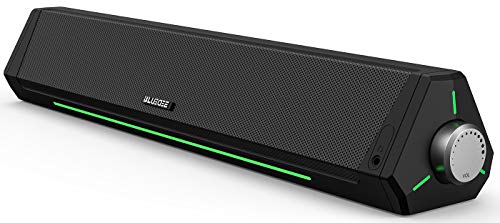
If you prioritize low-end audio frequency response for movies and music, the ULTIMEA 2.1ch Surround Sound System for TV offers impressive bass through its integrated subwoofer configuration. Meanwhile, budget-conscious buyers seeking reliable daily performance will appreciate the balance offered by the Bluedee Computer Speakers for Desktop PC.
Pairing your new soundbar with quality external desktop monitors ensures a clean and enjoyable workspace. By evaluating your connectivity preferences and sound requirements, you can easily choose a model that elevates your desktop audio experience.
Frequently Asked Questions
Are soundbars better than traditional desktop PC speakers?
Soundbars offer a unified single-body design that sits beneath your monitor, saving valuable desk real estate compared to separate twin satellite speakers. They reduce cable clutter while delivering focused forward-facing sound. However, traditional separated speakers can offer wider stereo separation in large rooms.
How do I connect a soundbar to my computer?
Most desktop soundbars connect using a USB cable for both power and digital audio delivery. Others rely on a standard 3.5mm AUX audio jack paired with a USB power plug. Wireless models also support Bluetooth pairing for cord-free connection to PCs, laptops, and mobile devices.
Can I use the Best Soundbars for a PC with a gaming monitor?
Yes, desktop soundbars work excellently alongside high-refresh-rate displays and HDMI monitors. If your monitor features audio passthrough ports or USB hubs, you can plug your soundbar directly into the display to keep desk wiring clean.
Do PC soundbars require an external power outlet?
Many compact PC soundbars run entirely on USB power supplied directly by your computer host or monitor hub. Portable options also include internal rechargeable batteries for cordless operation. Larger high-output systems with dedicated subwoofers may require a standard AC wall outlet.
What is the top feature to look for in Best Soundbars for a PC in 2026?
When reviewing options in 2026, the most important feature is versatile connectivity paired with full-range drivers. USB Type-C audio delivery and Bluetooth 5.0+ ensure low-latency performance and compatibility across desktop PCs, laptops, and mobile devices.
Can a soundbar fit under a dual-monitor stand setup?
Most soundbars designed for computers measure between 15 and 17 inches wide, making them slim enough to slide under dual-monitor arm mounts or elevated stand risers. Always measure your stand height clearance to ensure the speaker grille remains unblocked.
Is Bluetooth fast enough for video gaming without audio delay?
Modern Bluetooth 5.0 and 5.3 protocols significantly reduce audio latency compared to older wireless standards. While suitable for casual gaming and media streaming, competitive gamers still prefer direct wired USB connections for zero-latency audio synchronization.
Do I need driver software to install a PC soundbar?
Most USB and 3.5mm AUX soundbars operate as plug-and-play devices that work instantly without manual driver installation. Advanced models offer optional companion software apps to customize EQ curves, spatial audio effects, and RGB lighting patterns.