

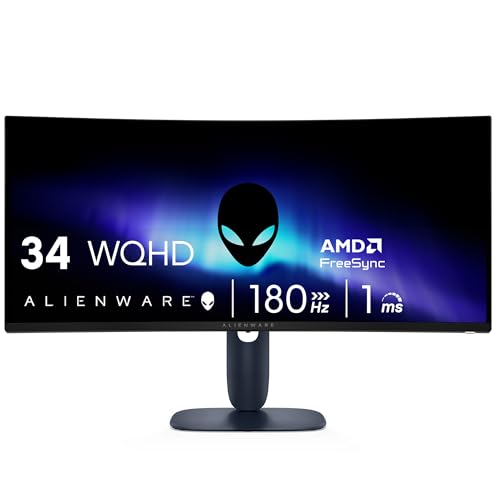
Selecting the ideal display setup starts with matching panel curvature to your daily workflow. For users seeking maximum screen space and clean sightlines, the Alienware 34 Curved Gaming Monitor – AW3425DWM delivers an expansive ultrawide workspace with minimal frame interference. We compared 7 Best Slim Bezel Curved Monitors in November 2026 to identify screens that maximize usable screen area across our Desktop & External Monitors lineup.
If you prefer a balanced 16:9 format for daily productivity and entertainment, the LG 32GS60QC-B Ultragear 32-inch Curved offers a sharp QHD view paired with a deeply immersive 1000R curve. Both options eliminate bulky borders to keep your attention centered entirely on your work.


Best Slim Bezel Curved Monitors Buying Guide
Bezel Width and Multi-Monitor Alignment
Narrow borders transform multi-screen workstations by eliminating the thick black gaps that traditionally break up wide visual fields. When placing two curved screens side by side, edge-to-edge glass allows your eyes to glide across spreadsheets and timelines without disruption. This cohesive view proves essential for video editors, financial traders, and creative professionals.
A three-sided borderless design keeps the top and sides practically invisible while leaving a modest bottom chin for structural stability. When comparing options on our Best Desktop Monitors guide, look for panels with minimal inner dead space beneath the outer casing. This design ensures that the active display area reaches as close to the physical edge as possible.
Curvature Ratings and Visual Ergonomics
Curvature is measured by radius in millimeters, where a smaller number indicates a tighter arc. A 1000R curve closely matches the natural contours of the human eye, keeping edges equidistant from your retinas. This tighter shape minimizes neck turning and ocular strain during extended sessions at your desk.
Gentler curves like 1500R provide subtle depth without feeling overly aggressive on wider ultrawide formats. If your workspace involves shared viewing or precise architectural drafting, a 1500R curve maintains straight horizontal references more effectively. Matching your typical viewing distance to the curve radius ensures the most comfortable computing experience.
Panel Resolution and Pixel Density
Screen size must always align with resolution to maintain sharp typography and clean graphical details. On a 27-inch display, 1080p Full HD provides dependable clarity for everyday document processing and casual viewing. However, stepping up to a 32-inch panel makes 2560×1440 QHD resolution essential to avoid visible pixelation.
Ultrawide 34-inch displays benefit greatly from WQHD resolution, giving you roughly 30 percent more horizontal desktop area than standard widescreen monitors. You can browse our recommendations for Best High Resolution Monitors to evaluate higher density displays. Sharp pixel density ensures that small spreadsheet numbers and code lines remain crisp throughout your workday.
Refresh Rates and Motion Smoothness
Refresh rates dictate how many times per second the display updates its visual image. Standard 75Hz to 100Hz panels provide noticeably smoother cursor tracking and web scrolling compared to legacy 60Hz displays. For office productivity and media consumption, a 100Hz display offers an immediate upgrade in overall desktop fluidity.
Demanding tasks and competitive gaming thrive on 165Hz to 300Hz panels paired with low 1ms response times. Fast refresh panels eliminate motion blur and ghosting during rapid window dragging or fast-paced gaming sequences. Adaptive sync technologies like AMD FreeSync keep the refresh cycle in lockstep with your graphics card to eliminate screen tearing.
Connectivity and Cable Integration
Versatile connectivity simplifies modern desktop setups and keeps cable clutter to an absolute minimum. Displays featuring USB-C with power delivery allow laptop users to transfer video signals and recharge their device over a single cable. This streamlined connection leaves your workspace clean and ready for quick docking.
Ensure your chosen screen includes multiple DisplayPort and HDMI inputs if you plan to connect several host computers or gaming consoles. Having dedicated DisplayPort 1.4 ports guarantees access to maximum refresh rates at native resolution. Checking port orientation on the rear panel also ensures easy access when setting up monitor arms.
Mounting Options and Stand Adjustments
Slim-bezel curved displays often feature minimalist stands designed to save valuable desk real estate. Tilt-adjustable stands provide basic angle customization, helping you align the screen to eye level. However, multi-monitor setups frequently require articulating monitor arms to achieve seamless panel alignment.
Standard 100x100mm VESA mount compatibility is crucial if you plan to float your displays above the desk surface. Removing the stock stands frees up significant desk area for keyboards, audio equipment, and notebooks. Always check the total monitor weight without the stand before selecting an aftermarket desk mount.
How We Evaluated
Our comparison evaluated 7 displays across verified technical specifications, panel performance, curvature measurements, and bezel construction. We analyzed how effectively each model maximizes visible screen real estate while maintaining structural stability and desktop ergonomics across varied home and professional office environments.
We prioritized displays offering balanced contrast ratios, broad color gamuts, and adaptable input options. By cross-referencing user use cases against refresh rates and mounting capabilities, we identified reliable selections tailored to productivity, casual entertainment, and fast-paced gaming.
Common Mistakes to Avoid
A frequent error is choosing a 32-inch monitor with only Full HD 1080p resolution. At that display size, lower pixel density causes jagged text and limits your usable multitasking space, making QHD resolution a far better choice.
Another mistake is ignoring curvature depth when planning a multi-screen array. Combining a 1000R screen with a 1500R screen creates an uneven viewing plane that disrupts eye tracking. Matching identical curve profiles ensures a unified visual arch across your desk.
Buyers also overlook port bandwidth limitations when connecting high-refresh displays. Using an older HDMI cable instead of DisplayPort can prevent your monitor from reaching its rated 180Hz or 300Hz speeds. Always verify that your computer outputs support the required refresh frequency over your chosen video interface.
Buying Checklist
- Confirm the bezel profile features a three-sided borderless frame for seamless dual-monitor alignment.
- Select a 1000R curve for maximum personal immersion or a 1500R curve for balanced wide-angle viewing.
- Choose at least 1440p QHD resolution for screens measuring 32 inches or larger.
- Verify that the monitor includes DisplayPort 1.4 or HDMI 2.0 to support your desired refresh rate.
- Check for USB Type-C connectivity if you plan to connect and charge a modern laptop via a single cord.
- Ensure standard 100x100mm VESA compatibility if you plan to mount the display on an adjustable arm.
- Review eye care features such as flicker-free backlighting and low blue light reading modes.
Final Thoughts
Upgrading to a curved display with ultra-thin borders dramatically enhances your daily visual comfort and workspace aesthetics. For users seeking an all-in-one productivity and gaming powerhouse, the Alienware 34 Curved Gaming Monitor – AW3425DWM remains our top overall recommendation thanks to its spacious WQHD panel and 180Hz fluidity.
If you need an affordable solution that simplifies laptop connectivity, the LG 27U421A-B 27-inch Full HD (1920 x 1080) delivers exceptional everyday utility with integrated USB-C power delivery. Meanwhile, competitive gamers will appreciate the blazing speed of the Z-Edge 27 inch Curved Gaming Monitor with its 300Hz refresh rate. You can explore our Best Quality Monitors guide for additional display configurations.
Selecting the right screen comes down to matching your primary tasks with the right curvature and panel resolution. With minimal frame bezels drawing you into your work, any of these displays will elevate your desktop environment throughout 2026.
Frequently Asked Questions
Why are slim bezels important on curved monitors?
Slim bezels maximize active screen surface and reduce visual distractions around the perimeter of the panel. When pairing two or more curved monitors, thin borders minimize the physical gap between screens, creating a continuous panoramic view across your entire desk.
What is the difference between 1000R and 1500R curvature?
The number indicates the radius of the curve in millimeters, meaning 1000R represents a tighter curve than 1500R. A 1000R arc closely matches human peripheral vision for deep immersion, while a 1500R curve offers a gentler bend that suits general desktop work and drafting.
Can I mount Best Slim Bezel Curved Monitors on monitor arms?
Yes, most models feature standard 100x100mm VESA mounting patterns on the rear panel. Using an aftermarket arm frees up desk space and allows you to adjust screen height, tilt, and swivel for optimal ergonomic positioning.
Is 1080p resolution sufficient for a 27-inch curved monitor?
Full HD 1080p resolution works well on a 27-inch screen at standard viewing distances for general web browsing and gaming. However, users who work extensively with small text or complex spreadsheets often prefer 1440p QHD for increased pixel sharpness.
What are the top features among Best Slim Bezel Curved Monitors in 2026?
Leading models in 2026 emphasize high refresh rates above 100Hz, three-sided frameless casings, and integrated eye care modes. Many modern displays also incorporate USB-C connectivity to support single-cable video and power delivery for laptops. You can check our IPS, OLED & LED Panels overview to learn more about underlying display tech.
Do curved monitors distort lines in graphic design work?
Curved panels can make straight horizontal lines appear slightly bent when viewed from extreme off-center angles. While most graphic designers adapt quickly to subtle 1500R curves, highly technical CAD drafting may still benefit from flat displays or ultra-wide panels with gentler curvature.
Does a higher refresh rate benefit general office tasks?
A higher refresh rate like 100Hz or 180Hz makes desktop navigation, document scrolling, and cursor tracking visibly smoother. This added fluidity reduces eye fatigue during long workdays, making everyday interactions feel noticeably more responsive.









