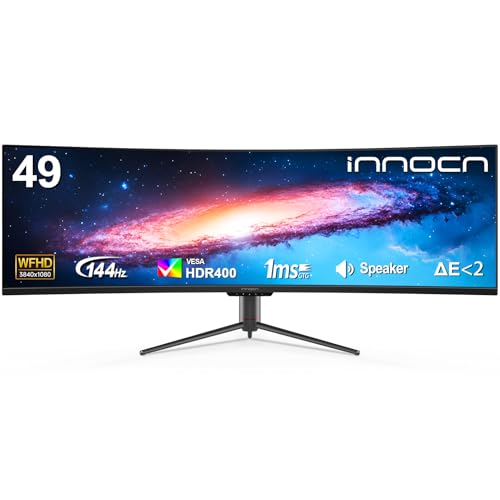
Finding the ideal large display requires balancing pixel density, desktop real estate, and smooth refresh rates for daily productivity. The INNOCN 49″ QD-OLED 5K2K 5120 x 1440P 144Hz is our top recommendation for power users who demand perfect black levels, deep color saturation, and expansive screen space. It replaces dual monitor setups effortlessly while maintaining sharp clarity across open windows.
For budget conscious shoppers seeking maximum horizontal space without spending premium sums, the INNOCN 49″ Curved Gaming Monitor 144Hz Ultrawide delivers exceptional value. We examined 5 models across the category in November 2026 to identify panels that pair well with high productivity workflows. You can also explore our guide to 4K, 6K & 8K monitors for additional high resolution display options.



Best 43 Inch 4K Monitors Buying Guide
Panel Resolution and Pixel Density
When selecting a massive desktop screen, resolution dictates how sharp your text and interface elements appear. A 5K2K dual QHD resolution provides ample horizontal space equivalent to two full size displays placed side by side. Lower resolutions like dual 1080p keep graphical demands manageable while still giving you tremendous workspace real estate.
Pixel density measures the clarity of fine details and text rendering on your screen. Larger screens need higher resolutions to avoid visible pixelation when viewed from standard desk distances. You can read more about visual sharpness in our review of high resolution monitors.
Panel Technology and Contrast Ratios
Panel construction fundamentally shapes your visual experience, affecting color accuracy, viewing angles, and black depth. QD-OLED panels offer per-pixel illumination with infinite contrast ratios and zero backlight bleed, making dark scenes vivid. Premium VA panels provide deep static contrast ratios around 3000:1, making them reliable options for daily productivity.
Color gamut coverage is another critical consideration for visual creators and media enthusiasts. Look for displays supporting at least 99 percent sRGB and VESA DisplayHDR certification to ensure rich color gradation. Learn about how different panel designs function in our detailed guide to panel technology.
Curvature and Viewing Comfort
Ultra wide screens require curvature to maintain a uniform distance between your eyes and the outer display edges. An 1800R curve brings the sides of the screen into your natural peripheral vision comfortably. This design significantly reduces neck strain because you do not have to swivel your head constantly across your desk.
Flat panels of this size often suffer from color shifting and optical distortion near the outer corners. An ergonomic stand with tilt, swivel, and height adjustments further enhances physical comfort throughout long sessions. Ensuring your monitor matches your seated eye level protects your posture during demanding projects.
Refresh Rates and Motion Clarity
Refresh rate determines how many times per second the display updates its visual image. While standard office displays operate at 60Hz, modern ultra wide screens offer 120Hz, 144Hz, or even 240Hz refresh rates. Faster refresh rates create fluid cursor movement and eliminate jarring motion blur during high tempo gameplay.
Adaptive sync technology pairs your monitor refresh rate directly with your graphics card output. This synchronization prevents screen tearing and reduces input stutter without adding latency. Fast pixel response times ensure moving objects remain crisp without leaving ghosting trails across the screen.
Connectivity and USB-C Power Delivery
Modern desk setups benefit immensely from versatile connectivity options that reduce cable clutter. High bandwidth ports like HDMI 2.1 and DisplayPort 1.4 allow you to drive full resolutions at high refresh rates. Built-in USB hubs let you connect peripherals directly to the display chassis.
A full-featured USB-C port with power delivery transmits display signal, data, and laptop charging power through one cable. Higher wattage ratings, such as 65W or 90W, can charge modern laptops while in heavy use. This one cable solution keeps your desktop tidy and facilitates swift docking.
Picture-in-Picture and Split Screen Tools
Expansive screen sizes excel at multitasking by letting you arrange multiple applications side by side effortlessly. Picture-by-Picture and Picture-in-Picture modes allow the monitor to display video inputs from two distinct computers simultaneously. This feature is invaluable for professionals who manage both a work laptop and a personal workstation.
Integrated KVM switches let you control multiple connected devices using a single keyboard and mouse set. Transitioning between different machines becomes instantaneous without unplugging cables or adjusting hardware. Built-in window management software further simplifies custom grid layouts for peak daily productivity.
How We Evaluated
Our evaluation process is built upon objective analysis of verified manufacturer specifications, technical capabilities, and real-world utility. We analyzed display resolution, panel type, contrast performance, and refresh capabilities across 5 leading models. We examined how each feature benefits various computing workflows from office multitasking to competitive gaming.
We also assessed ergonomic adjustability, port selections, and energy delivery specifications to determine daily practical value. Trade-offs between panel speed, color accuracy, and overall pricing were weighed transparently to help readers make informed choices. Our focus remains on delivering data-driven clarity without relying on unsupported claims.
Common Mistakes to Avoid
- Ignoring Desktop Depth: Placing an expansive screen on a shallow desk puts your eyes too close to the panel, causing eye fatigue. Ensure your desk has at least 30 inches of depth for comfortable viewing.
- Overlooking Graphics Card Output: High resolution 5K2K displays at 144Hz or 240Hz require modern graphics cards with DisplayPort 1.4 or HDMI 2.1 support to run at full potential.
- Underestimating USB-C Wattage: Connecting a demanding workstation laptop to a 65W USB-C port may result in slow battery drain under heavy computing loads.
- Skipping Curved Ergonomics: Choosing a flat wide display over a curved panel increases neck strain and causes noticeable color distortion at extreme viewing angles.
Buying Checklist
- Confirm your desk width and depth accommodate a 49-inch curved chassis comfortably.
- Check that your computer GPU has DisplayPort 1.4 or HDMI 2.1 video outputs.
- Verify the monitor USB-C power delivery wattage matches your laptop charging requirements.
- Choose between QD-OLED for deep contrast or VA panels for reliable productivity value.
- Ensure the display includes an adjustable stand for height, tilt, and swivel ergonomics.
- Determine whether you need Picture-by-Picture mode for dual-computer workstation setups.
- Review the monitor refresh rate to ensure it meets your gaming performance targets.
Final Thoughts
Choosing the right ultra wide display transforms your daily computing setup into an expansive command center. For top-tier visual performance, the INNOCN 49″ QD-OLED 5K2K 5120 x 1440P 144Hz is our best overall pick due to its vibrant QD-OLED panel and robust 90W USB-C hub. It delivers unbeatable contrast for both intensive content creation and high fidelity entertainment.
If you want massive desktop space on a sensible budget, the INNOCN 49″ Curved Gaming Monitor 144Hz Ultrawide serves as the best value pick with its smooth 144Hz refresh rate. Competitive gamers looking for extreme motion fluidity will appreciate the INNOCN 49″ 5K2K 240Hz QD-OLED Curved for its lightning fast 240Hz refresh rate. Check out our recommendations on external computer monitors to explore more versatile workstation options.
Frequently Asked Questions
What is the top-rated option among Best 43 Inch 4K Monitors in 2026?
The INNOCN 49″ QD-OLED 5K2K 5120 x 1440P 144Hz stands out as our top pick for 2026. It combines pristine QD-OLED contrast, sharp 5120 x 1440 resolution, and versatile 90W USB-C connectivity for a premium experience.
Are ultra wide curved monitors better than dual monitor setups?
Ultra wide displays eliminate central bezels to give you a continuous visual canvas across your entire workspace. They simplify desk cable management and offer seamless window snapping without annoying gaps between screens.
How much desk depth do I need for a large curved display?
A desk depth of at least 30 inches is recommended to maintain a comfortable viewing distance from the screen. This distance allows your eyes to take in the full curved display without excessive neck strain or eye fatigue.
Can I connect two computers to one screen simultaneously?
Yes, models equipped with Picture-by-Picture support allow you to display video feeds from two separate computers side by side. This lets you manage work and personal machines on a single physical display effortlessly.
What is the advantage of QD-OLED over traditional VA panels?
QD-OLED technology provides individual pixel illumination, resulting in perfect black levels and infinite contrast ratios. Traditional VA panels are more cost-effective but rely on backlights that cannot achieve true zero-nit black depths.
Does USB-C power delivery charge high-end laptops effectively?
Monitors with 90W USB-C power delivery provide sufficient juice to charge modern productivity laptops while streaming video and data. Lower 65W ratings work well for standard ultrabooks but may charge high-power laptops more slowly under load.
Is a 144Hz refresh rate noticeable for office productivity?
Higher refresh rates make mouse cursor movement smoother and reduce eye fatigue during rapid window scrolling. While standard 60Hz displays function fine, 120Hz or 144Hz panels deliver a noticeably more responsive everyday desktop feel.
Where can I find more high resolution screen recommendations?
You can read our comprehensive guide on high resolution monitors for productivity to evaluate additional panel sizes and visual configurations tailored to your workflow.