

Building a showpiece rig requires exceptional visibility alongside reliable thermal performance for demanding gaming components. For November 2026, our top choice among 5 contenders in Best Front Window PC Cases: Panorama Builds is the MUSETEX Y6 PC Case, Pre-Installed 7 Infinity. It pairs seamlessly with premium gaming monitors thanks to its seamless 270-degree dual tempered glass design and seven vibrant pre-installed prism fans.
Builders seeking a clean aesthetic without active illumination can look toward the MUSETEX Y6 PC Case, Pre-Installed 4 Non-LED Fans for incredible interior space. It delivers identical component clearance and dual-chamber thermal routing while maintaining an understated profile on your desk. Check Price on Amazon →
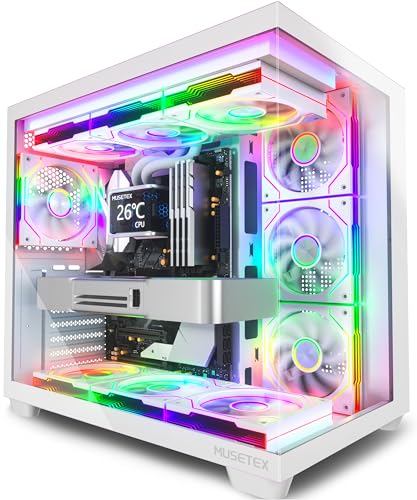


Best Front Window PC Cases: Panorama Builds Buying Guide
Glass Panel Architecture and Corner Visibility
Panoramic enclosures stand out by removing the bulky corner support pillar that traditionally blocks the interior view. Dual tempered glass panels meet at a seamless angle to provide an unobstructed 270-degree showcase for internal components. This design turns your graphics card, custom cabling, and liquid coolers into a central visual centerpiece for sleek monitor setups.
When evaluating seamless glass panels, check the mounting mechanism and panel thickness to ensure structural durability. Quality cases utilize tool-free snap mechanisms or discrete rear thumb screws that keep the glass face completely smooth. Thicker glass dampens fan noise effectively, though it adds significant weight to the final chassis assembly.
Airflow Management and Reverse Blade Fans
Solid glass front panels require a specialized internal airflow strategy to maintain low operating temperatures. Modern panoramic cases draw fresh air from side vents and bottom intake channels rather than traditional front mesh panels. This layout directs cool air straight across the graphics card before exhausting heated air through top and rear vents.
Reverse blade fans are critical for maintaining aesthetic appeal while pulling air into the chassis. Standard intake fans show their rear support brackets, which disrupts the clean look of the glass interior. Reverse blade designs present the finished fan face to the viewer while functioning as high-efficiency intake units.
Component Clearance and Radiator Support
High-end graphics cards continue to expand in both overall length and thickness with each new generation. A quality panoramic case should comfortably accommodate graphics cards extending up to 410 millimeters without blocking side intake fans. Verifying maximum CPU cooler height and power supply depth ensures your chosen parts fit without physical conflicts.
Liquid cooling enthusiasts must inspect top and side radiator mounting clearances before purchasing their hardware. Most panoramic mid-towers support top-mounted 360-millimeter radiators to dissipate heavy processor heat loads efficiently. Proper clearance above the motherboard prevents thick radiators from colliding with tall memory heat spreaders.
Dual-Chamber Design and Cable Organization
Because panoramic cases expose the entire interior to view, hiding clutter becomes essential for a professional build. Dual-chamber layouts place the power supply, storage drives, and extra cabling behind the motherboard tray. This separation isolates heat sources and creates an ultra-clean presentation in clean desktop builds.
Look for built-in routing channels, tie-down loops, and rubber grommets that simplify harness management during assembly. Emerging chassis designs also support back-connect motherboards, routing all major connectors directly to the rear compartment. This feature keeps the main display chamber completely free from visible power wires.
Front Panel Connectivity and Port Options
Accessible input ports ensure you can connect high-speed peripherals and charging cables without reaching behind the desk. A modern front I/O cluster should provide a dedicated USB Type-C port alongside standard USB 3.0 connections. Combined audio jacks allow seamless connectivity for gaming headsets and external desktop microphones.
The physical placement of the I/O panel also affects everyday convenience based on your desk setup. Top-mounted or lower-side ports allow easy access whether the computer sits on the floor or on a tabletop. Selecting a case with durable switches ensures reliable power control over years of daily operation.
Dust Filtration and Long-Term Maintenance
Transparent glass enclosures highlight accumulated dust quickly if intake paths remain unprotected. Magnetic dust filters on top, bottom, and side intake vents capture airborne particles before they settle on sensitive hardware. Maintaining positive internal air pressure by using more intake fans than exhaust fans further prevents dust buildup.
Removable slide-out filters beneath the power supply compartment make regular cleaning quick and effortless. Easy maintenance preserves optimal airflow paths and keeps internal components running cooler for longer periods. Regular upkeep ensures your transparent glass panels continue to showcase a spotless system interior.
How We Evaluated
Our evaluation process focuses on rigorous technical comparison across verified manufacturer specifications and architectural design features. We analyzed chassis dimensions, component clearance thresholds, cooling fan configurations, and materials quality across 5 models. Each design was scored on how effectively it balances unobstructed panoramic views with thermal performance and building convenience.
We also examined cable routing flexibility, modular bracket options, and front-panel connectivity standards. By comparing airflow configurations and dual-chamber thermal separation, we identified cases that protect high-wattage components reliably. This data-driven approach highlights realistic trade-offs to help you choose the ideal enclosure for your specific setup.
Common Mistakes to Avoid
Installing standard fans as side intakes is a frequent aesthetic error in panoramic builds. Standard fans expose rear support struts to the main viewing window, whereas reverse blade fans preserve clean visual lines. Choosing reverse fans maintains proper intake airflow without compromising the showcase look of your chassis.
Failing to verify graphics card length against side-mounted radiators can lead to severe clearance conflicts during assembly. Long triple-fan graphics cards may collide with thick liquid cooling radiators installed on the side mounting rail. Always measure total GPU length and subtract front or side radiator thickness to guarantee adequate clearance.
Overlooking motherboard internal header compatibility is another common pitfall when choosing modern computer enclosures. If your motherboard lacks a native USB Type-C front-panel header, the case port will remain nonfunctional without an adapter. Checking motherboard specifications prior to assembly ensures all exterior ports function properly from day one.
Buying Checklist
- Confirm GPU length clearance accommodates your specific graphics card model with at least 20 millimeters of spare space.
- Verify top radiator support matches your liquid cooler dimensions, such as 240-millimeter or 360-millimeter sizing.
- Ensure CPU air cooler height clearance exceeds your heatsink specifications if you are not using liquid cooling.
- Check that your motherboard includes the appropriate internal header for front-panel USB Type-C connectivity.
- Select reverse blade fans for side and bottom intake locations to maintain clean visual presentation through glass panels.
- Confirm power supply depth fits within the lower dual-chamber compartment alongside excess modular power cables.
- Inspect magnetic dust filter placement across all active air intake zones for straightforward periodic maintenance.
- Determine whether your selected chassis supports back-connect motherboards if you desire a completely cable-free main chamber.
Final Thoughts
Selecting the right enclosure transforms your custom personal computer from a simple workstation into an eye-catching centerpiece. For the ultimate visual experience, the MUSETEX Y6 PC Case, Pre-Installed 7 Infinity stands out as our top overall recommendation. Its seven pre-installed infinity mirror fans and 270-degree pillarless glass panels look spectacular beside 4K and ultrawide displays.
Builders on a tighter budget who prefer a stealthy appearance will appreciate the MUSETEX Y6 PC Case, Pre-Installed 4 Non-LED Fans. It retains the same spacious dual-chamber interior layout and expansive component support while delivering quiet, unlit cooling. If modular flexibility and specialized front airflow brackets match your goals, consider the CORSAIR 4000D RS ARGB Frame Modular Mid-Tower ATX for its versatile rail system.
Frequently Asked Questions
Do panoramic front window PC cases have poor airflow compared to mesh cases?
Modern panoramic enclosures maintain strong thermal performance by drawing cool air through dedicated side and bottom intake vents. Directing bottom airflow straight into the graphics card while venting hot air out the top creates an efficient cooling chimney. This specialized layout delivers cooling comparable to traditional mesh chassis designs.
What is the top-rated option among Best Front Window PC Cases: Panorama Builds in 2026?
The MUSETEX Y6 PC Case, Pre-Installed 7 Infinity ranks as our leading pick for 2026 thanks to its impressive feature set. It includes seven speed-adjustable prism fans, 270-degree dual tempered glass panels, and generous space for large graphics cards. You can explore more hardware recommendations in our custom PC build guides.
Why do panoramic glass cases use reverse blade fans?
Reverse blade fans draw air into the chassis while presenting their decorative front hubs toward the clear glass panels. Traditional intake fans display their motor hubs and support struts, which disrupts the clean aesthetic of transparent enclosures. Reverse fans solve this dilemma by providing high-efficiency intake airflow with an immaculate presentation.
Can these panoramic cases fit large graphics cards like the RTX 4090?
Yes, modern panoramic mid-towers are engineered to support graphics cards measuring up to 410 millimeters in length. This generous clearance provides ample room for massive flagship cards alongside side-mounted cooling fans. Always verify case depth to ensure wide cards have sufficient clearance for power cable bend radii.
What is the benefit of a dual-chamber chassis layout?
A dual-chamber design isolates the power supply, storage drives, and excess cables in a separate rear compartment. This arrangement leaves the main glass viewing chamber completely uncluttered, highlighting key motherboard and cooling components. Separating the power supply also prevents its thermal output from warming the main component chamber.
Are back-connect motherboards supported in modern panoramic cases?
Several modern modular chassis support hidden-connector motherboards such as ASUS BTF, MSI Project Zero, and Gigabyte Stealth. These cases incorporate specialized cutouts around the motherboard tray that allow power cables to connect entirely from the rear. This creates an exceptionally pristine build where zero power cables cross the front chamber.
How do you keep tempered glass panels clean and scratch-free?
Clean tempered glass panels using a soft microfiber cloth lightly misted with an ammonia-free glass cleaner. Avoid paper towels or abrasive cleaning agents, as they can cause micro-scratches on tempered glass coatings over time. Regularly wiping dust from external surfaces keeps your hardware display crystal clear.
Do I need a 360mm liquid cooler for a panoramic PC build?
A 360-millimeter liquid cooler is not mandatory, but it provides optimal thermal headroom for high-wattage modern processors. Mounting a 360-millimeter radiator in the top exhaust position complements the bottom-to-top airflow design of panoramic cases. Air coolers can also be used effectively, provided their height remains under the case clearance limit.









