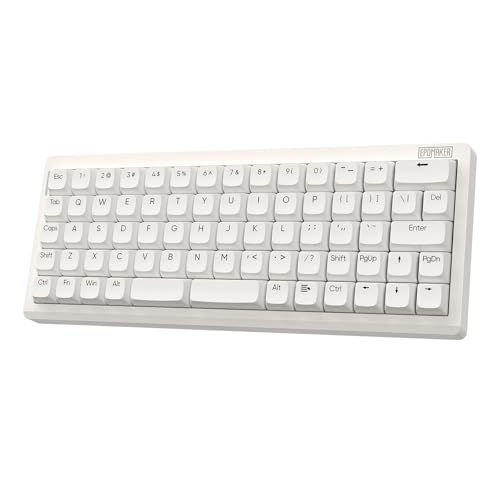

When searching for the Best Ortholinear Keyboards in October 2026, straight matrix alignment helps reduce finger reach and wrist fatigue during long typing sessions. Our top pick for most writers and coders is the EPOMAKER Hack70 Planck Mechanical Keyboard because it balances an approachable grid layout with reliable wireless options.
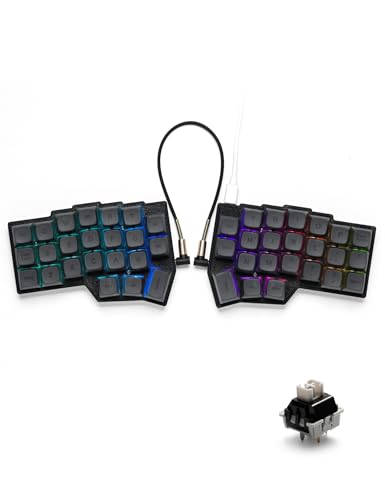
If you want a budget-friendly split model, the KBDcraft 07Israfel 50% Ergo-Split Low-Profile provides customizable tilt angles and hot-swappable switches without a heavy investment. You can also pair these compact input tools with our top picks for best external computer monitors to build an ergonomic workstation. Check Price on Amazon →


Best Ortholinear Keyboards Buying Guide for 2026
Straight Grid vs Columnar Staggering
Traditional keyboards arrange keys in diagonal staggered rows inherited from historical typewriter mechanics. Matrix layouts align keys in straight vertical and horizontal columns so your fingers move strictly up and down.
Columnar staggering goes one step further by adjusting column offsets to match differing finger lengths. This design keeps your hands in a natural posture while reducing lateral movements during intensive typing sessions.
Switching to a matrix grid requires a brief adaptation period as your muscle memory adjusts. Most users find that typing accuracy improves significantly once their fingers get used to straight vertical travel paths.
Split Enclosures vs Unibody Frames
Split designs separate the keyboard into two independent halves connected by a cable or wireless signal. This physical separation allows you to align each side directly with your shoulder width to prevent wrist bending.
Unibody ortholinear frames maintain a single rigid chassis while arranging keys in straight matrix columns. They offer exceptional desk stability and portability while still eliminating awkward diagonal key reaching.
Choosing between split and unibody depends primarily on your desk space and mobility needs. If you regularly move between remote locations, a compact unibody model like those in our how to optimize desk ergonomics guide may prove more convenient.
Key Profile and Switch Selection
Standard mechanical switch profiles offer deep travel distances and vast aftermarket customization options. Low profile switches feature half the physical height, reducing wrist extension without requiring a dedicated wrist rest.
Switch feel plays a crucial role in overall comfort during prolonged coding or writing marathons. Linear switches offer smooth keystrokes, while tactile switches provide gentle tactile feedback to confirm key actuation.
Hot-swappable switch sockets let you change your switch preferences without touching a soldering iron. This feature ensures you can tune your tactile experience over time as your typing preference evolves.
Programmability via QMK, VIA, and VIAL
Compact ortholinear layouts often rely on secondary key layers to replace physical function and number rows. Modern open-source firmware like QMK, VIA, and VIAL allows you to assign any command to any key.
Layers function similarly to the shift key by transforming the entire board into a dedicated number pad or navigation cluster. Onboard memory saves these custom keymaps directly to the hardware across all operating systems.
VIAL software provides real-time mapping adjustments through a graphical interface without requiring complicated firmware compilations. This seamless control helps power users optimize their personal productivity shortcuts quickly.
Connectivity and Battery Flexibility
Wired USB-C connections deliver absolute zero-latency response and constant power for backlit RGB displays. Wireless 2.4GHz dongles provide fast response times while eliminating cable clutter across your workspace.
Multi-device Bluetooth connections allow you to pair your keyboard with laptops, tablets, and smartphones simultaneously. You can easily switch between operating systems with simple key combinations during your workday.
If you plan to pair your keyboard setup with best hi res monitors, wireless connectivity helps maintain a clean, organized desk aesthetic.
How We Evaluated
We analyzed 7 models across leading brands like KBDcraft, YIVU, EPOMAKER and more to determine which boards offer the best balance of ergonomics and performance. Our evaluation focused on key layout alignment, physical chassis stability, switch responsiveness, and firmware flexibility.
We examined objective specifications, layer mapping capabilities, switch compatibility, and physical build materials across the $69.99 – $129.00 price spectrum. This data-driven analysis ensures our recommendations suit both beginners and experienced keyboard enthusiasts.
Common Mistakes to Avoid
Buying an ortholinear layout without expecting an adjustment period often leads to premature frustration. Muscle memory requires several days of regular practice to adapt from traditional diagonal key stagger to straight matrix alignment.
Ignoring layer programmability is another frequent error among newcomers to compact layouts. Failing to set up comfortable layer shortcuts forces unnecessary hand movements, defeating the primary ergonomic purpose of small key counts.
Choosing non-standard keycap profiles can complicate future keycap replacements on matrix boards. Uniform keycap profiles maintain geometric consistency across grid rows, making custom key replacement much easier over time.
Forgetting to verify wireless dongle latency before gaming can affect fast-paced competitive gameplay. Always choose dedicated 2.4GHz low-latency connections over standard Bluetooth when swift input transmission is required.
Buying Checklist
- Confirm whether you prefer a true split body or a unibody ortholinear layout for your desk setup.
- Verify that the keyboard PCB supports QMK, VIA, or VIAL for easy layer remapping.
- Check if the board features hot-swappable switch sockets to easily replace mechanical switches.
- Determine whether low profile or standard profile key switches match your wrist support needs.
- Ensure the wireless model includes a 2.4GHz USB receiver for low-latency wireless performance.
- Validate that keycap legends match your preferred operating system layout across Windows or macOS.
- Review battery capacity specs if you plan to rely on wireless Bluetooth connections daily.
Final Thoughts
Selecting one of the Best Ortholinear Keyboards can dramatically lower joint strain and streamline your digital workflow. Among the 7 models we analyzed, the EPOMAKER Hack70 Planck Mechanical Keyboard stands out as our best overall pick due to its approachable layout and robust wireless features.
For users who prioritize thin profiles and premium aluminum build quality, the EPOMAKER Luma40 Low Profile Mechanical Keyboard offers exceptional tactile performance. If you want to experiment with split ergonomics on a budget, the KBDcraft 07Israfel 50% Ergo-Split Low-Profile delivers incredible value.
Pairing these ergonomic input tools with high-quality desktop displays from our guide on high-resolution displays creates a comfortable and productive workspace.
Frequently Asked Questions
What makes the Best Ortholinear Keyboards more ergonomic than standard keyboards?
Matrix layouts align keys in straight vertical and horizontal columns instead of diagonal rows. This structural alignment eliminates awkward finger reaching, reduces wrist twist, and minimizes long-term joint strain during typing.
How long does it take to get used to an ortholinear keyboard in 2026?
Most users adapt to straight grid typing within three to seven days of consistent use. While your initial typing speed may drop temporarily, muscle memory adjusts quickly to the simplified movement patterns.
Can I use an ortholinear keyboard for programming and gaming?
Yes, ortholinear boards excel at programming because custom firmware allows you to map complex symbols and shortcuts directly to your home row. Gamers also benefit from low-latency 2.4GHz wireless modes and compact footprints that free up mouse pad space.
What is the difference between QMK, VIA, and VIAL firmware?
QMK is open-source firmware that controls key mappings, while VIA and VIAL offer real-time graphical interfaces for editing those mappings. VIAL is especially beginner-friendly because key adjustments update instantly on hardware memory without needing code compilation.
Are split ortholinear keyboards better than unibody matrix designs?
Split keyboards allow you to place each half shoulder-width apart, which opens your chest and prevents wrist deviation. Unibody matrix designs keep the board stable in a single piece, making them more portable for mobile work environments.
Do I need special keycaps for an ortholinear layout board?
Many ortholinear boards use 1u size keycaps across all grid rows, requiring flat uniform profiles like DSA or XDA. Standard mechanical keycap sets may not include enough single-unit modifier keys for full layout coverage.
What is the top budget pick among Best Ortholinear Keyboards in 2026?
The KBDcraft 07Israfel 50% Ergo-Split Low-Profile is an outstanding budget option that offers ergo-split flexibility, hot-swappable switches, and programmable layers. You can learn more about organizing your ergonomic workstation by browsing our how to optimize desk ergonomics section.