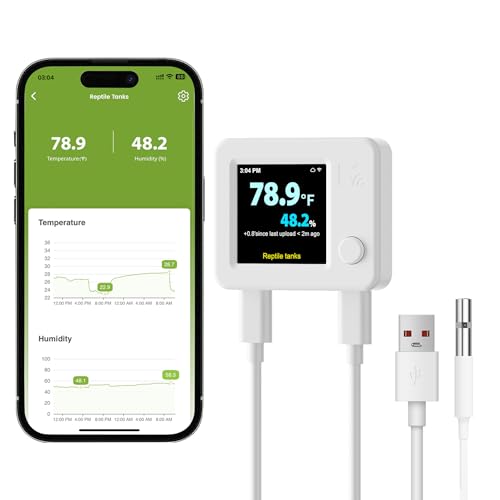

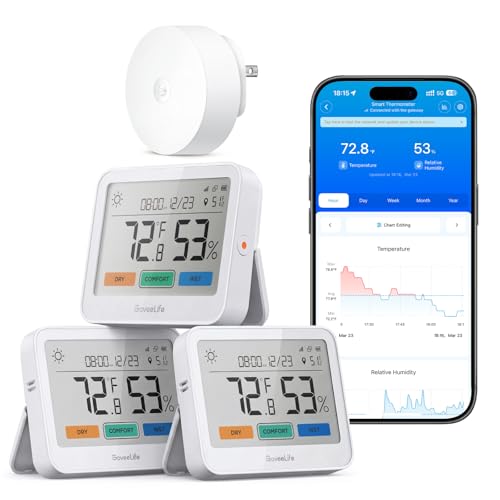
Choosing the Best Smart Humidity Sensors for Reptile Enclosures: Habitat monitoring requires reliable accuracy and timely moisture notifications. We recommend the GoveeLife WiFi Thermometer Hygrometer 5-in-1 for keepers who need expansive wireless coverage and dependable threshold alerts across multiple vivariums in September 2026.
If you manage high humidity tropical terrariums or rain chambers, the MOCREO WiFi Reptile Thermometer Hygrometer serves as our top cabled probe option with continuous power. You can discover more habitat automation tips in our how-to guides before reviewing all 7 featured options.




Best Smart Humidity Sensors for Reptile Enclosures: Habitat Buying Guide
Sensor Accuracy and Calibration
Reptiles rely heavily on stable environmental moisture to shed properly and avoid respiratory infections. Selecting a monitor with a Swiss-made sensing component ensures readings remain accurate within tight tolerances of two to three percent relative humidity.
Sensors can experience baseline drift over months of continuous exposure to elevated humidity. Choosing a device with in-app calibration allows you to adjust offset values against a standard salt test, maintaining reliable readings throughout the year.
Wireless Protocol and Gateway Connectivity
Wireless communication determines how quickly you receive warnings when conditions fall out of safe ranges. Standard Bluetooth models provide straightforward direct pairing, but they only deliver notifications when your phone is within short range of the enclosure.
Dedicated Wi-Fi and Zigbee setups utilize central gateways to transmit real-time telemetry straight to the cloud. This continuous connection allows keepers to check vivarium parameters from work or travel, ensuring complete peace of mind while away from home.
Moisture Resistance and Probe Placement
Tropical reptile setups require frequent misting cycles that can quickly corrode unprotected internal circuitry. Utilizing an external display connected to a water-resistant probe keeps sensitive electronics safely isolated from direct water spray.
Flat sensor cables slip easily through mesh screen tops or ventilation gaps without requiring custom enclosure drilling. If you keep a monitoring workstation nearby, pairing it with desktop and external displays makes managing complex vivarium data charts straightforward.
Alert Notifications and Threshold Customization
A monitoring system is only as effective as the speed and visibility of its warning mechanisms. Top units combine smartphone push alerts, automated emails, and audible hub buzzers to alert you the instant humidity drops below vital minimums.
Customizable threshold buffers prevent false alarms caused by brief ventilation cycles or momentary door openings. Setting appropriate upper and lower boundaries ensures you receive alerts only when conditions genuinely threaten your reptile.
Data Logging and Smart Home Automation
Long-term data logging lets keepers track seasonal fluctuations and evaluate day versus night microclimate variations. Free cloud storage with spreadsheet export capabilities helps diagnose subtle husbandry issues before they harm your animal.
Advanced smart sensors can trigger automated routines through smart plugs to activate misting nozzles or exhaust fans. Connecting these sensors to your home network creates a self-regulating ecosystem that maintains ideal relative humidity automatically.
How We Evaluated
We evaluated each device by analyzing manufacturer specifications, sensor response times, wireless transmission ranges, and companion app performance. Our evaluation focused on long-term data logging capabilities, hardware durability in humid environments, and overall alert reliability.
We compared connectivity standards across Bluetooth, Wi-Fi, and Zigbee ecosystems to assess how each unit integrates into modern habitat setups. Special consideration was given to calibration options, power supply designs, and ease of physical placement within reptile terrariums.
Common Mistakes to Avoid
Placing an unprotected main unit directly under heavy automatic misting nozzles often leads to premature circuit failure. Always position non-waterproof housings outside the tank while extending only rated probes into damp tropical microclimates.
Relying exclusively on Bluetooth sensors without a Wi-Fi gateway leaves your enclosure unmonitored whenever you leave home. A sudden heating lamp failure or stuck humidifier cannot trigger an away-from-home alert without internet connectivity.
Neglecting periodic sensor calibration can allow gradual humidity drift to go completely unnoticed. Verifying sensor readings every six months prevents chronic dehydration or respiratory issues caused by inaccurate hygrometer data.
Buying Checklist
- Confirm sensor accuracy is rated within plus or minus three percent relative humidity.
- Check whether the wireless protocol requires a dedicated gateway for remote internet access.
- Verify that the sensor probe has adequate water resistance for high misting habitats.
- Ensure the companion app offers customizable high and low threshold alerts.
- Check if the device supports historical data storage and free file exports.
- Confirm the power source uses standard replaceable batteries or continuous USB power.
- Look for in-app calibration settings to correct potential long-term reading drift.
- Verify smart home ecosystem compatibility if you plan to automate misting equipment.
Final Thoughts
Selecting the right monitor creates a stable living environment for your animals while taking the stress out of daily husbandry. For whole-room coverage and versatile notifications, the GoveeLife WiFi Thermometer Hygrometer 5-in-1 stands out as our top overall recommendation.
Keepers operating wet tropical setups will appreciate the continuous power and probe design of the MOCREO WiFi Reptile Thermometer Hygrometer. If you want a compact and cost-effective local gauge, the Govee Indoor Hygrometer Thermometer H5075 delivers exceptional accuracy on a modest budget.
Investing in a dependable smart sensor ensures your vivarium climate remains perfectly balanced throughout 2026. You can explore additional workspace setup advice in our review of quality computer displays to track your pet habitat telemetry with ease.
FAQs
What are the Best Smart Humidity Sensors for Reptile Enclosures: Habitat choices in 2026?
The top options combine precise sensing elements, wireless notifications, and durable designs. Units like the GoveeLife WiFi Thermometer Hygrometer 5-in-1 and the MOCREO WiFi Reptile Thermometer Hygrometer lead the category in reliability.
How often should reptile hygrometers be calibrated?
We recommend checking calibration every six months using a standard salt slurry test. High humidity environments can accelerate sensor drift, making regular verification essential for animal safety.
Can these sensors withstand direct water spray from misting systems?
Standard sensor bodies are vulnerable to moisture ingress, but dedicated probe models handle regular misting cycles safely. Always keep primary electronic units and battery compartments outside wet vivarium zones.
What is the difference between Bluetooth and Wi-Fi humidity sensors?
Bluetooth monitors transmit data directly to your phone within short line-of-sight distances. Wi-Fi enabled monitors upload readings to the cloud, allowing you to receive instant alerts from any location.
Can smart humidity sensors automatically turn on a reptile fogger?
Yes, many smart sensors connect with automated smart plugs through companion apps or third-party hubs. When humidity levels drop below your target threshold, the sensor triggers the plug to run your humidifier.
Why is vapor pressure deficit important in a terrarium?
Vapor pressure deficit measures the drying power of the air by comparing temperature and moisture saturation. Tracking this metric helps bioactive terrarium keepers maintain healthy live plants alongside optimal conditions for reptiles.
Where is the best place to position a humidity sensor inside an enclosure?
Place sensors near the middle of the enclosure at the animal’s typical living height. For comprehensive oversight, you can learn more about environment setup through our smart habitat guides.