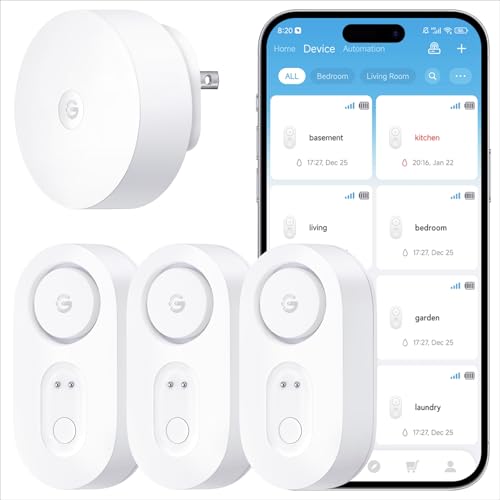
Subterranean wine cellars and dedicated storage rooms face constant risks from burst pipes, evaporator leaks, and groundwater intrusion. The How To section offers broader home maintenance guidance, but safeguarding valuable bottles requires long-range wireless detection that penetrates thick walls. For most wine enthusiasts, the GoveeLife Upgraded Smart Water Leak Detector 1s is the top choice because its Sub-1G technology provides reliable long-range signals through dense basement construction.
If you prefer a direct pipe-monitoring solution that tracks water volume without touching floor surfaces, the Bluebot Mini Smart Water Meter Bundle offers clamp-on ultrasonic tracking. For budget-conscious collectors needing wide coverage across several racking zones, the Geevon 2 Pack Water Leak Detectors,100dB Sensor delivers clear local alerts without requiring a wireless hub.



Best Water Leak Sensors for Wine Cellars Buying Guide
Wireless Transmission and Wall Penetration
Wine cellars are frequently located in enclosed subterranean basements constructed from thick concrete, brick, or insulated vapor barriers. Standard 2.4GHz Wi-Fi signals often struggle to pass through these dense structural layers to reach main home routers. Devices using specialized Sub-1G long-range wireless protocols maintain stable connections over far greater distances.
When selecting sensors for secluded cellars, evaluate signal range ratings alongside physical barrier resistance. A sensor capable of transmitting through multiple walls ensures that sudden leaks trigger immediate notifications on your mobile device. Dropped connectivity leaves your wine collection unprotected during unexpected plumbing or cooling equipment failures.
Notification Speed and Alert Methods
A water leak in a wine storage room can ruin expensive custom cabinetry and corrupt bottle labels within hours. Multi-channel alerting systems combine loud local sirens with instant mobile app push notifications, text messages, and email updates. This layered approach ensures you are notified whether you are upstairs or traveling away from home.
Local audible alarms should produce sound levels of at least 100dB to remain audible through closed cellar doors. Mute options accessible via mobile apps allow quick silence once a leak is acknowledged, giving you calm focus while addressing the water source. Exploring equipment monitoring strategies helps refine your overall alert system setup.
Physical Sensor Probes and IP Ratings
Wine cellars present high ambient humidity environments that can cause false trips on poorly calibrated equipment. High-quality sensors feature corrosion-resistant metal probes embedded on both top and bottom surfaces to detect dripping overhead water or pooling floor moisture. Gold-plated or stainless steel contacts resist rust during prolonged contact with humid floor surfaces.
Ingress Protection ratings indicate how well a device resists moisture, dust, and full immersion. An IP67 rating ensures the sensor continues operating even if completely submerged during severe flooding. Slim enclosure profiles with low heights allow effortless placement underneath low-clearance bottle racks, sumps, or condensate drip pans.
Non-Invasive Flow Detection vs Point Sensors
Point-of-leak sensors detect water only after it reaches the floor surface where probes are located. Ultrasonic flow meters take a proactive approach by clamping onto main supply pipes to track baseline water movement. These non-invasive monitors analyze gallon usage patterns and identify micro-leaks hiding inside walls or ceiling pipes before water spills out.
Installing clamp-on meters requires no pipe cutting or professional plumbing services. Combining an ultrasonic flow monitor on supply lines with point sensors on cellar floors creates comprehensive defense. This dual strategy guards against both internal pipe failures and external cooling unit condensate overflows.
Battery Longevity and Maintenance
Maintaining wine cellar equipment should require minimal ongoing effort once hardware is positioned. High-efficiency sensors with optimized radio components can operate for several years on standard replaceable batteries or sealed power cells. Long battery lifespans eliminate frequent maintenance visits into tight cellar corners.
Low-battery notifications delivered through mobile apps prevent devices from dying silently without your knowledge. Devices using standard 9V or AAA batteries offer easy maintenance, while multi-year sealed units reduce disposal waste. Check app battery status indicators periodically to confirm active protection across all installed nodes.
How We Evaluated
We analyzed 5 lead market options across price points ranging from $12.99 – $258.76 to identify top performers for wine storage protection. Our evaluation focused on verified technical specifications, wireless range ratings, acoustic decibel output, ingress protection standards, and battery efficiency metrics. We examined device performance data across various cellar layouts, concrete wall configurations, and high-humidity environments.
Our structural comparison prioritizes objective data including transmission protocols like Sub-1G versus standard Wi-Fi, probe material quality, app configuration flexibility, and multi-channel alert delivery options. Devices offering clear app interfaces, simple setup routines, and reliable multi-point sensor bundles received strong weight in our overall assessment.
Common Mistakes to Avoid
Placing standalone alarms without wireless connectivity inside isolated subterranean cellars is a frequent oversight. While a 100dB siren is loud, heavy insulation and concrete walls can muffle sound, preventing you from hearing alerts on upper floors. Always choose network-connected models or Sub-1G hub systems if your cellar is secluded.
Ignoring ambient humidity levels during installation can cause frustrating false alarms. Low-grade sensors without moisture-sealed enclosures often trigger when relative humidity spikes near refrigeration coils. Select sensors rated IP66 or IP67 to guarantee stable operation in humid wine storage conditions.
Positioning sensors too far from potential failure points creates dangerous delay during sudden leaks. Water travels along natural floor slopes and low grooves before pooling in open areas. Place detection probes directly beneath AC drip pans, plumbing joins, and perimeter walls where water first enters.
Buying Checklist
- Confirm wireless transmission protocols can breach your cellar wall density and distance.
- Verify local alarm volume reaches at least 100dB for audible alerts nearby.
- Ensure mobile notifications include free app push, email, or SMS alerts.
- Check that floor sensors feature an IP66 or IP67 waterproof rating.
- Measure height clearances under cooling units and bottom wine racks.
- Choose stainless steel or gold-plated probe contacts to prevent rust.
- Select systems with low-battery app alerts to avoid unexpected power loss.
- Determine whether point-of-leak probes or ultrasonic pipe clamp meters fit your layout.
Final Thoughts
Selecting the Best Water Leak Sensors for Wine Cellars in 2026 protects delicate vintages from catastrophic moisture damage. For deep subterranean storage rooms with thick concrete walls, we recommend the GoveeLife Upgraded Smart Water Leak Detector 1s due to its long-range Sub-1G wireless transmission and comprehensive app notification suite. Reviewing our hardware configuration guides can help you integrate smart monitoring tools into your home routine.
If you want whole-pipe monitoring that tracks overall water flow without floor sensors, the Bluebot Mini Smart Water Meter Bundle delivers exceptional ultrasonic flow data directly to your smartphone. For wine collectors seeking straightforward local alarms on a budget, the Geevon 2 Pack Water Leak Detectors,100dB Sensor provides instant acoustic warnings whenever water contacts its base probes.
Frequently Asked Questions
Why are special leak sensors needed for wine cellars?
Wine cellars are often located in isolated basements with thick concrete walls and high ambient humidity. Standard wireless sensors can lose signal through heavy masonry, while low-quality probes may corrode or cause false alarms in damp environments.
What is the benefit of Sub-1G technology in the Best Water Leak Sensors for Wine Cellars in 2026?
Sub-1G technology operates on lower wireless frequencies that penetrate dense concrete, brick, and vapor barriers far better than standard Wi-Fi. This ensures your cellar sensors remain connected to their hub over long distances up to 1804 feet.
Where should water sensors be placed in a wine room?
Place floor sensors directly beneath cooling unit condensate lines, near plumbing pipe entries, and along the lowest point of cellar flooring. You can also explore tech placement tips for optimal positioning of connected monitoring hubs.
Can high humidity trigger false leak alarms?
Poorly designed sensors without sealed housings may short-circuit or trip when humidity levels rise near active cooling systems. Quality cellar sensors use moisture-sealed IP66 or IP67 casings to isolate electronic components from ambient humidity.
How long do batteries last in water leak detectors?
Battery life varies depending on transmission protocol and usage patterns, ranging from 1 year on standard 9V batteries up to 5 years on energy-efficient Sub-1G smart sensors. Most mobile apps display remaining battery capacity and send replacement alerts.
Do clamp-on pipe sensors replace floor leak detectors?
Clamp-on ultrasonic flow meters track water movement inside supply pipes to spot plumbing leaks early, while floor sensors detect external spills and condensate pan overflows. Combining both devices creates complete protection for your storage space.
Are mobile app notifications reliable when away from home?
Smart leak sensors linked to internet hubs send real-time push notifications, emails, or SMS messages to your smartphone wherever you have cellular signal. Multi-channel alerts ensure you receive instant warnings regardless of your physical location.